
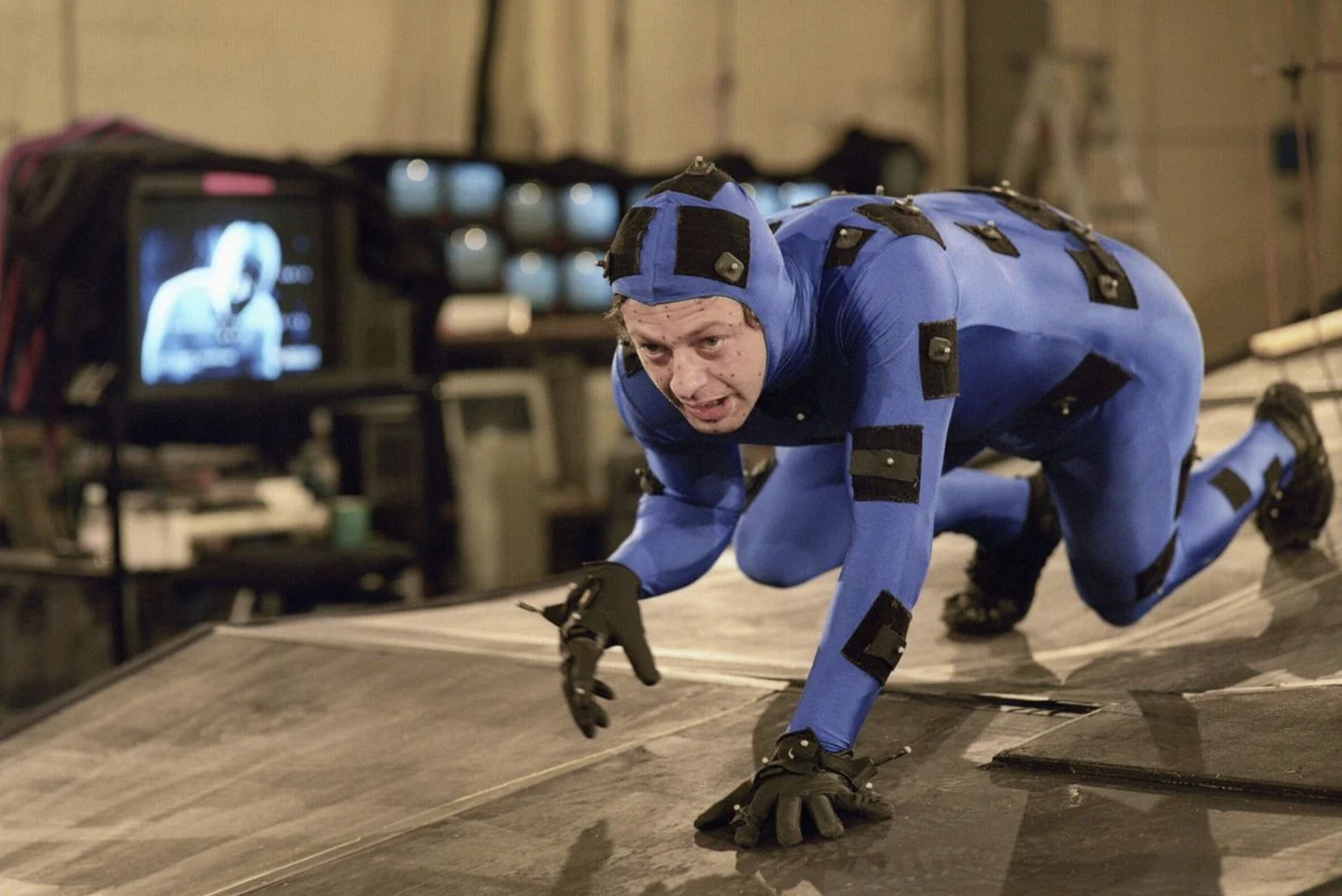
Andy Serkis as GollumIN DEFENCE OF FRICTION
When Andy Serkis was cast as Gollum he made a decision that nobody required him to make. The role could have been handled differently. The voice in a booth, the movement delegated to animators, the character assembled from the outside in. This was an available option. It was, by most reasonable professional metrics, the sensible option. Serkis looked at it and chose not to take it, and then went and did something considerably stranger instead.
He contorted. He moved on all fours across sets for months. He produced sounds from somewhere that didn't have a name yet and followed those sounds into a physicality that also didn't have a name yet and kept going until the thing that didn't have a name became, through sustained and undignified effort, a character. Not depicted from a distance. Inhabited. The contortion was not the obstacle to finding Gollum. The contortion was how you found Gollum. Remove the difficulty and you remove the discovery. What lives inside the resistance cannot be reached by the path that goes around it.
There is a cost to this worth naming. Serkis has spent the majority of his career invisible. Caesar. Kong. Gollum. The performances are total and the performer is gone, consumed by the commitment, erased by the completeness of the craft. He gave everything to the work and the work took his face with it. A generation of cinema shaped by his performances would not recognise him on the street. The friction didn't just produce better work. It produced work that made the person doing it disappear. Which is either the purest form of artistic integrity available or the most extreme proof of what choosing the hard way actually costs. Probably both.
This would remain a piece about one actor's unusual choices if the friction weren't being removed everywhere, right now, at a speed that makes it difficult to track what is being lost in the removal. The brief that writes itself. The image generated from a prompt. The algorithm that tells you what the audience wants before you have made the thing. All of it presented as progress. All of it pointed in the same direction, toward the elimination of resistance, toward the removal of difficulty that was, without credit, producing things that could not have existed without it.
The question is not whether the tools are good. The question is what we are not finding. What lives only inside the difficulty. What could only emerge from the wrong sound becoming the right sound, from the discovery that no prompt could have anticipated. The frictionless path gets you to a destination you could already describe before you set off. The friction takes you somewhere that didn't exist until you went there.
Serkis went all the way in, every time, at the cost of his own visibility, without the guarantee that the form he was inventing would be recognised as a form. The form was in the friction. It was always in the friction.
The easy way is right there. Increasingly it is easier than it has ever been and harder to refuse on any grounds that don't sound slightly precious when stated out loud. The question Serkis answered, every time without being asked, is whether that is actually the point.
It isn't. It never was.